
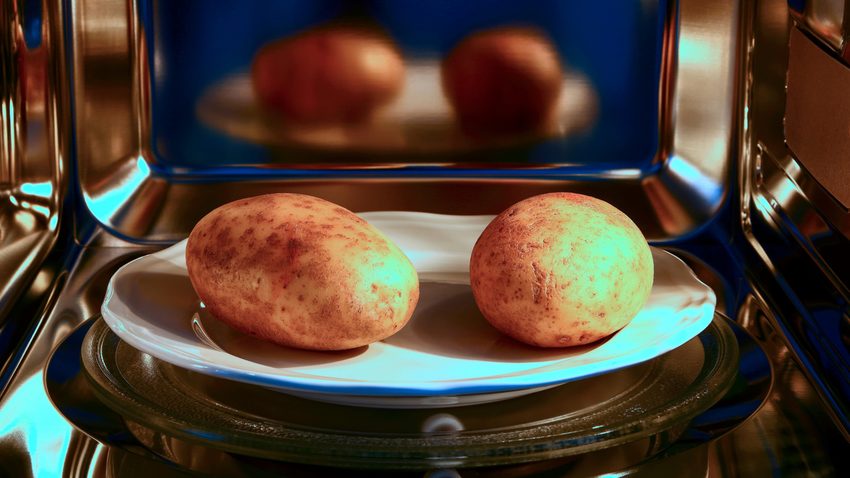
Cooking with a microwave is often linked with speed. Put food inside, set a cooking time, and when the timer hits zero, you can count on it to be done. But a slightly different strategy works well with potatoes. The few minutes that follow microwaving might be just as crucial as the actual cooking time.
Resting allows a potato’s internal moisture and heat to redistribute. A softer core, more uniform texture, and a more pleasurable baked potato may be achieved by letting it rest for a little while rather than chopping into it right away. Microwave preparation may be made much more dependable by understanding this little step.
A Potato Keeps Cooking After The Microwave Stops
When the microwave radiation ceases, a potato does not instantly turn cool. A significant amount of heat is still retained behind the skin and continues to pass through the potato.
Because microwave cooking does not always heat every area of food at precisely the same time, this residual heat is very helpful. It’s possible for one area to become a little more sore than another. Heat from warmer regions progressively migrates toward cooler regions when one is at rest.
This implies that after resting for a few minutes, a potato that seems barely cooked when taken out of the microwave may become substantially softer. This process is quickly stopped by cutting it open, which also releases heat that may otherwise contribute to the final texture.
Moisture Settles Inside When You Rest
Heat is not the only factor that determines texture. The soft interior that consumers anticipate from a baked potato is also greatly influenced by moisture.
The potato’s inherent water boils quickly in the microwave, producing steam. A portion of this steam quickly escapes when the potato is opened. time passes, the flesh continues to soften, allowing the potato to stay whole for a little longer and retain more of the warm liquid within.
For this reason, instead of having certain parts that are very soft and others that stay somewhat solid, resting might make the inside feel more uniformly delicate.
Therefore, for anybody learning how to microwave a potato, resting should be considered a necessary step in the cooking process rather than a choice to postpone eating.
Why Cutting Right Away May Impact The Outcome
When making a fast lunch or supper, it might be tempting to slice a potato as soon as the microwave whistles. But as soon as you open it, the atmosphere within is altered.
In essence, the skin surrounds the body with a temporary barrier that retains heat and steam. The heat that has been stored in the potato swiftly escapes as it is split. There is less leftover heat available to complete the task if the core has not fully softened.
Another way to make the potato easier to handle is to wait a little while before chopping. Resting offers a textural benefit as well as a more pleasant serving experience since a recently microwaved potato may produce very hot steam when opened.
Resting Cannot Fix An Undercooked Potato
Resting has a significant impact, but it shouldn’t be used in place of adequate cooking.
More microwave time will usually be required if the center is still noticeably hard. When the potato has achieved or is almost at softness, resting is most effective.
Using a fork to check might be beneficial. The thickest area should be easily penetrated by the fork. Before trying it again, put the potato back in the microwave for a brief heating period if it has trouble penetrating the middle.
This method is preferable to drastically increasing the initial cooking time, which might result in the exterior parts drying up before the center is cooked.
Conclusion
A simple method that may significantly enhance microwave-baked potatoes is resting. It helps the center achieve a more uniform softness, permits residual heat to pass through the potato, and provides internal moisture time to redistribute.
Consider resting as the last phase of cooking rather than seeing the microwave timer as the ultimate finish. These extra minutes might be the difference between an uneven potato and one with a soft, delicious inside, even though they don’t involve any more work or energy.